 English
 中文简体
中文简体

Direct Answer: The most common challenges in die casting mold design with automatic trimming include parting line misalignment, uncontrolled flash formation, gate and runner system complexity, ejection system integration, thermal management, and maintaining tight dimensional tolerances — all of which can significantly impact product quality and production efficiency.
As manufacturing industries push toward higher automation and leaner production cycles, integrating automatic trimming systems into die casting mold design has become both a priority and a technical challenge. While automation reduces labor costs and increases repeatability, it introduces a new layer of complexity in mold engineering that designers must carefully address.
This article examines the most significant engineering obstacles faced in die casting mold design when automatic trimming is incorporated, offering practical insights and structured comparisons to help engineers and procurement specialists make informed decisions.
1. Parting Line Design and Flash Control
One of the most fundamental challenges in any die casting mold with automatic trimming is defining and maintaining an accurate parting line. The parting line determines where the two halves of the mold meet and directly influences how trim tools engage the part.
Why Flash Is a Persistent Problem
Flash — thin fins of excess metal — forms when molten alloy penetrates the parting line gap under injection pressure. In manual trimming, operators can adjust for irregular flash. But with automatic trimming, the trim die must be precisely engineered to match flash profiles consistently.
- High injection pressure increases flash volume along the parting line
- Complex 3D parting surfaces make trim tool contact inconsistent
- Wear over thousands of cycles gradually worsens flash sealing
- Thermal expansion during production shifts parting line contact pressure
2. Gate and Runner System Integration with Trim Tools
In die casting mold design, the gate and runner system delivers molten metal to the cavity. When automatic trimming is involved, the removal of gates, overflows, and runners must be factored into both the mold design and the downstream trim die geometry.
Key Design Conflicts
| Design Element | Challenge in Manual Trimming | Challenge in Automatic Trimming |
| Gate Location | Operator adjusts cut angle manually | Trim die must align exactly each cycle |
| Runner Geometry | Flexible manual separation | Complex runner shapes require custom punches |
| Overflow Wells | Cut individually with hand tools | Must be positionally consistent for automation |
| Biscuit/Sprue | Removed by saw or chisel | Requires dedicated knockout and shear sequence |
3. Ejection System Compatibility
Automatic trimming requires that castings are delivered to the trim press in a consistent, repeatable orientation. This places significant demands on the ejection system within the die casting mold.
Common Ejection-Related Issues
- Uneven ejection force causing part distortion before trimming
- Ejector pin marks placed in areas interfering with trim die locating surfaces
- Part sticking in the mold due to insufficient draft angle, delaying automated handling
- Ejection timing conflicts with robotic extraction in high-speed cells
Designers must coordinate ejector pin placement, draft angles (typically 1°–3° for aluminum), and part geometry to ensure smooth release and repeatable positioning on conveyor or robot gripper systems feeding the trim press.
4. Thermal Management and Dimensional Stability
Heat is a persistent enemy of dimensional accuracy in die casting mold design. During high-pressure injection, mold surfaces experience extreme thermal cycling — often between 150°C and 300°C — which causes expansion, contraction, and eventual fatigue cracking.
Thermal Challenges Specific to Auto-Trimming Setups
- Hot spots near thick sections cause localized shrinkage, altering trim reference edges
- Inconsistent cooling leads to part warpage — especially problematic in flat, large castings
- Trim die alignment depends on part flatness; warped parts cause die collision risk
- Thermal drift across a production shift changes part dimensions cumulatively
| Cooling Strategy | Effectiveness | Cost | Best Used For |
| Conventional Water Channels | Moderate | Low | Simple geometries |
| Conformal Cooling (3D printed) | High | High | Complex cavities with hot spots |
| Spray Cooling (external) | Moderate-High | Medium | Large flat dies |
| Beryllium-Copper Inserts | Very High | Very High | Critical dimensional zones |
5. Trim Die and Mold Synchronization
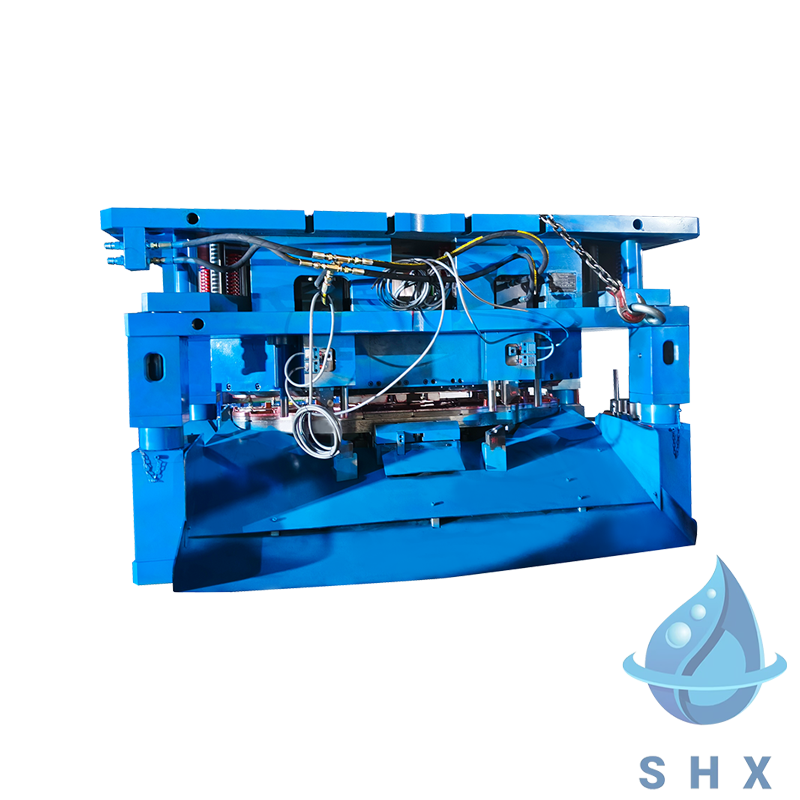
Automatic trimming doesn't operate in isolation — it must be synchronized with the die casting mold cycle in terms of part geometry, timing, and mechanical compatibility. Mismatches between the casting mold and the trim die are among the most costly problems in automated die casting cells.
Synchronization Failure Points
- Gate and overflow positions in the casting mold not matching trim punch layout
- Part shrinkage rates not accounted for in trim die locating pin design
- Different thermal expansion rates between casting and trim tooling materials
- Engineering change to casting mold not reflected in updated trim die revision
Best practice requires simultaneous design of both the die casting mold and the trim tool, using shared 3D models and strict revision control to ensure any casting geometry change is immediately reflected downstream.
6. Surface Quality and Burr Formation at Trim Edges
Even when trimming is automated, the quality of cut edges on castings remains a significant concern. Poor die casting mold or trim die design can lead to burrs, tearing, or cracking at trim locations — requiring secondary deburring that defeats the purpose of full automation.
- Clearance between punch and die: Too tight causes galling; too loose leaves large burrs
- Gate web thickness: Excessively thick gates require high trim force, risking part deformation
- Material temperature at trimming: Trimming too hot reduces precision; too cold increases cracking risk
- Trim die wear: Progressive edge wear leads to burr escalation without monitoring
Manual Trimming vs. Automatic Trimming: A Comparative Overview
| Factor | Manual Trimming | Automatic Trimming |
| Setup Cost | Low | High |
| Cycle Time | Slow (operator-dependent) | Fast and consistent |
| Trim Precision | Variable | High repeatability |
| Mold Design Complexity | Lower tolerance requirements | Strict geometric constraints |
| Labor Cost (Long-term) | High | Low |
| Flexibility for Design Changes | High | Low (requires retooling) |
| Best for Volume | Low to medium | High volume production |
Best Practices for Overcoming Die Casting Mold Design Challenges
- Co-design the mold and trim tool simultaneously using shared CAD data and parametric models
- Use simulation software (flow analysis, thermal FEA) to predict flash zones and optimize cooling before cutting steel
- Standardize part orientation on the trim press fixture to minimize locating variation
- Specify gate web thickness between 1.5–2.5mm to balance trimming force and metal fill quality
- Implement preventive maintenance schedules for both casting mold and trim die to track wear progression
- Conduct DFMEA (Design Failure Mode and Effect Analysis) focused specifically on trim-related failure modes
Frequently Asked Questions (FAQ)
Q: What is the ideal draft angle for a die casting mold with automatic trimming?
For aluminum die castings, a draft angle of 1° to 3° on external walls and 2° to 4° on internal cores is generally recommended. Sufficient draft ensures clean ejection and consistent part orientation for trim die loading without risking surface damage.
Q: At what temperature should castings be trimmed in an automatic system?
The optimal trimming window for aluminum die castings is typically between 200°C and 350°C (still semi-warm after ejection). Trimming in this range allows the metal to shear cleanly without cracking while still providing enough ductility to avoid tearing at thin gate sections.
Q: How does mold steel selection affect trimming performance?
H13 tool steel is the industry standard for aluminum die casting molds due to its excellent thermal fatigue resistance. For trim die components, D2 or M2 tool steels are commonly used for their wear resistance. Mismatched material hardness between mold and trim tools can lead to accelerated wear at contact interfaces.
Q: Can simulation software predict trimming challenges during mold design?
Yes. Modern mold flow analysis tools can predict flash formation zones, thermal gradients, and potential warpage areas. These insights allow engineers to redesign gate locations, cooling channels, and parting line geometry before any hard tooling is cut, saving significant time and cost.
Q: Is automatic trimming suitable for all die casting mold types?
Automatic trimming is best suited for high-volume, geometrically consistent parts with clearly defined flash and gate locations. For prototype runs, low volumes, or highly complex parts with numerous thin-walled features, manual or semi-automatic trimming remains more cost-effective and flexible.
Conclusion
Designing a die casting mold for use with automatic trimming is a multidisciplinary engineering challenge. From controlling flash at the parting line to synchronizing ejection systems with robotic handling, every design decision in the casting mold has downstream consequences for trimming quality and overall production efficiency.
The key to success lies in integrated co-design — treating the casting mold and trim tool as a single system rather than two independent components. Teams that adopt this philosophy, supported by simulation tools and structured DFMEA processes, consistently achieve better part quality, lower scrap rates, and longer tooling life.
As automation continues to define the future of high-pressure die casting, mastering the design challenges outlined here will be essential for manufacturers aiming to stay competitive in precision metalworking markets.
 +0086-18158459905